
How Bench Warrants Work in McDuffie County
A McDuffie County bench warrant usually grows from an existing court matter rather than a new accusation. Georgia's uniform misdemeanor rules allow a court to issue a warrant when a person does not appear at the time and place stated on a citation. The order directs apprehension and may allow a reasonable bond. A judge may also address contempt or another unmet court order through bench process, but the wording in the actual McDuffie County file controls.
Thomson Municipal Court gives the clearest local example. Its public material says failure to pay or appear can add a late amount, lead to license suspension, and result in an arrest warrant for failure to appear. Magistrate and Superior Court can also control missed settings in matters within their jurisdiction. Juvenile proceedings follow restricted access rules. None of these records is made complete by a public county list, because no official McDuffie County online warrant roster was found.
McDuffie County Missed-Date Sequence
A Thomson citation shows how one event can create separate court and state consequences. If a payable, non-mandatory citation is handled before the assigned date, the city accepts its stated payment routes. If the date passes without payment or appearance, the ticket may stop appearing through the online or automated phone channel. The Municipal Court clerk then becomes the key contact.
The court warrant and a Georgia DDS failure-to-appear suspension are not the same record. DDS says suspension takes effect no more than 28 days after it receives notice. Clearing the court matter should therefore be followed by proof of recall and, when needed, confirmation that DDS received the release.
Bench Warrant Issuance in McDuffie County
A judge issues the bench warrant after the court records a failure to appear or another breach of a court duty. The statewide misdemeanor rule permits an optional notice procedure that can allow 30 days, but it does not require a court to use that step. A McDuffie County reader should not assume a grace period exists unless the issuing clerk confirms it for the case.
After issuance, the warrant remains tied to the court file. The McDuffie County Sheriff may serve or hold warrant information, while Thomson Police may serve process arising from city cases. Georgia has no single statewide public name-search portal. GCIC is a criminal-justice system, not a public search. That is why the court named on the notice and the sheriff warrant line must be checked as separate sources.
Thomson Bench Warrant Recall in McDuffie County
The official Thomson Municipal Court answers state that, in the missed-date situation they describe, full payment of the fine plus a $100 contempt fee recalls the warrant and closes the case. The answer also says a DDS reinstatement form is supplied if needed. This published route is specific to the Thomson matter described, not a universal McDuffie County bond or recall schedule.
The screenshot shows why a person should call the clerk after the date has passed. It also supports keeping the receipt, recall confirmation, and DDS release rather than treating a payment screen as the last step.
How Bench and Arrest Warrants Differ
Both orders may authorize custody, but they begin at different points. A McDuffie County bench warrant follows a missed court obligation in an existing matter. An arrest warrant rests on probable cause for an alleged offense, often after sworn facts are reviewed by Magistrate Court. The companion McDuffie County arrest warrant explanation covers that sworn application and service path.
| Feature | Bench Warrant | Arrest Warrant |
|---|---|---|
| Starting point | Missed setting, contempt, or unmet court duty | Probable cause for an alleged offense |
| Issuer | Judge in the existing case | Authorized Georgia judge or magistrate |
| Local file | Municipal, Magistrate, Superior, or restricted Juvenile file | Application, warrant, and later criminal case records |
| Resolution | Recall, quash, reset, payment, appearance, or bond as ordered | Surrender, booking, bond if allowed, and criminal case proceedings |
McDuffie County Bench Warrant and Capias Terms
McDuffie County public pages use “bench warrant,” “failure to appear,” “warrant,” and “recall.” They do not publish capias pro fine as the standard local label. Capias is a general term for court process directing custody, while capias pro fine is often linked to fine enforcement. Those terms should not be placed onto a McDuffie County record unless the court document actually uses them.
- Failure to appear
- Not attending or responding as a citation or court order requires.
- Recalled
- The issuing court has withdrawn the warrant; ask for court proof.
- Quashed
- The court has set aside the process by order, which does not necessarily dismiss the case.
- Cleared
- Informal status language that needs confirmation because the underlying case may remain open.
Clearing a Bench Warrant in McDuffie County
The safest route begins by identifying the issuing court. A sheriff confirmation does not recall an order, and an Open Records request does not clear it. McDuffie County has published no universal walk-in hour, motion form, or recall fee schedule. A person should call first, ask what the court requires, and consider legal advice before any in-person warrant inquiry because Georgia warns that immediate custody may follow.
- Read the citation, notice, or case paper and identify Municipal, Magistrate, Superior, or Juvenile Court.
- Call that clerk and ask whether the warrant remains active, whether a reset or motion is needed, and whether counsel may arrange the next step.
- Call the McDuffie County warrant line at 706-597-3862 if service, surrender, booking, or bond may be involved.
- Complete the court-directed payment, appearance, recall, quash, or bond step, then obtain written proof and a new court date.
- For traffic FTA matters, confirm that any needed DDS release was sent and processed.
Caution: Do not arrive for an unplanned warrant check. Confirm the McDuffie County court, custody risk, bond terms, and required documents first.
McDuffie County Bench Warrant Continuance Records
A claimed reason for missing court does not itself erase a bench warrant. Thomson Municipal Court lists death in the family, hospitalization, incarceration, another court date, a mandatory school test, and military leave as possible continuance circumstances. Its instructions say documentation must reach the clerk no later than 48 hours before the original setting. Once the date has passed, the clerk and judge control what can still be done.
Gather the court notice, case or citation number, proof of the circumstance, and any payment receipt before calling. Ask whether the judge needs a written request, a new appearance, or action by an attorney. McDuffie County has not published a general bench-warrant motion or a countywide walk-in docket, so copying a procedure from another Georgia court could waste time or make the case harder to track.
McDuffie County Courts That Issue Bench Warrants
The issuing court controls recall, reset, plea, and the next hearing. Thomson Municipal Court handles city traffic, ordinances, and certain misdemeanors. McDuffie Magistrate Court handles criminal warrants, first appearances, and county ordinance or disorderly-conduct matters. Superior Court handles felony files and other general-jurisdiction matters. Juvenile Court records are restricted and must be routed through the clerk under the applicable access rules.
| Court | McDuffie County route | Contact |
|---|---|---|
| Thomson Municipal | Traffic, city ordinance, qualifying misdemeanor FTA | 309 Main Street; 706-597-7385 |
| Magistrate | Criminal warrants, first appearances, county ordinance matters | 210 Railroad Street, Room 1401; 706-597-2618 |
| Superior | Felony files, court orders, domestic-relations matters | 210 Railroad Street, Room 1401; 706-595-2134 |
| Juvenile | Restricted youth matters | Clerk route; 706-595-2134 |
McDuffie County Bench Warrant Access Boundaries
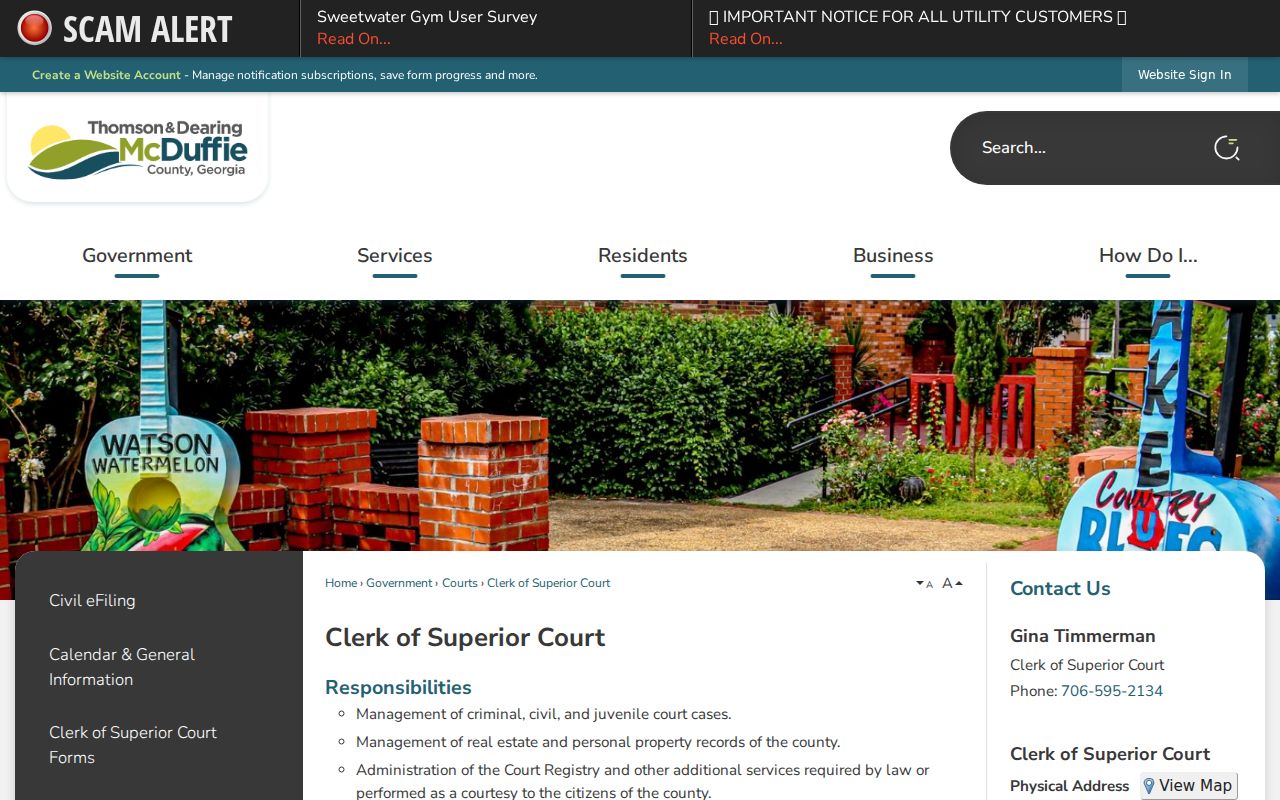
The McDuffie Clerk of Superior Court page identifies the local clerk route and explains that court files are generally open except juvenile, adoption, and court-sealed records. That boundary matters when a bench warrant cannot be confirmed from ordinary public material.
The Georgia Open Records Act may provide a written request route for existing sheriff records, but it does not force an office to create a new warrant list. A response within three business days can also explain delay, fees, redaction, or a lawful restriction. For a bench warrant, the most useful proof remains the issuing court's current status and written recall or release.